7 Reasons Why Leg Steaks Suck

- 7 Reasons Why Leg Steaks Suck - October 22, 2026
- 5 Wild Northern Fruits That Taste Tropical - September 29, 2026
- Summertime Chanterelle and Vegetable Medley - July 20, 2026
You pick up your deer from the processor, get home, crack open the box, and start stacking packages in the freezer.
Ground venison. Roasts. Tenderloin. Maybe some backstrap.
Then you hit the pile marked VENISON LEG STEAK.
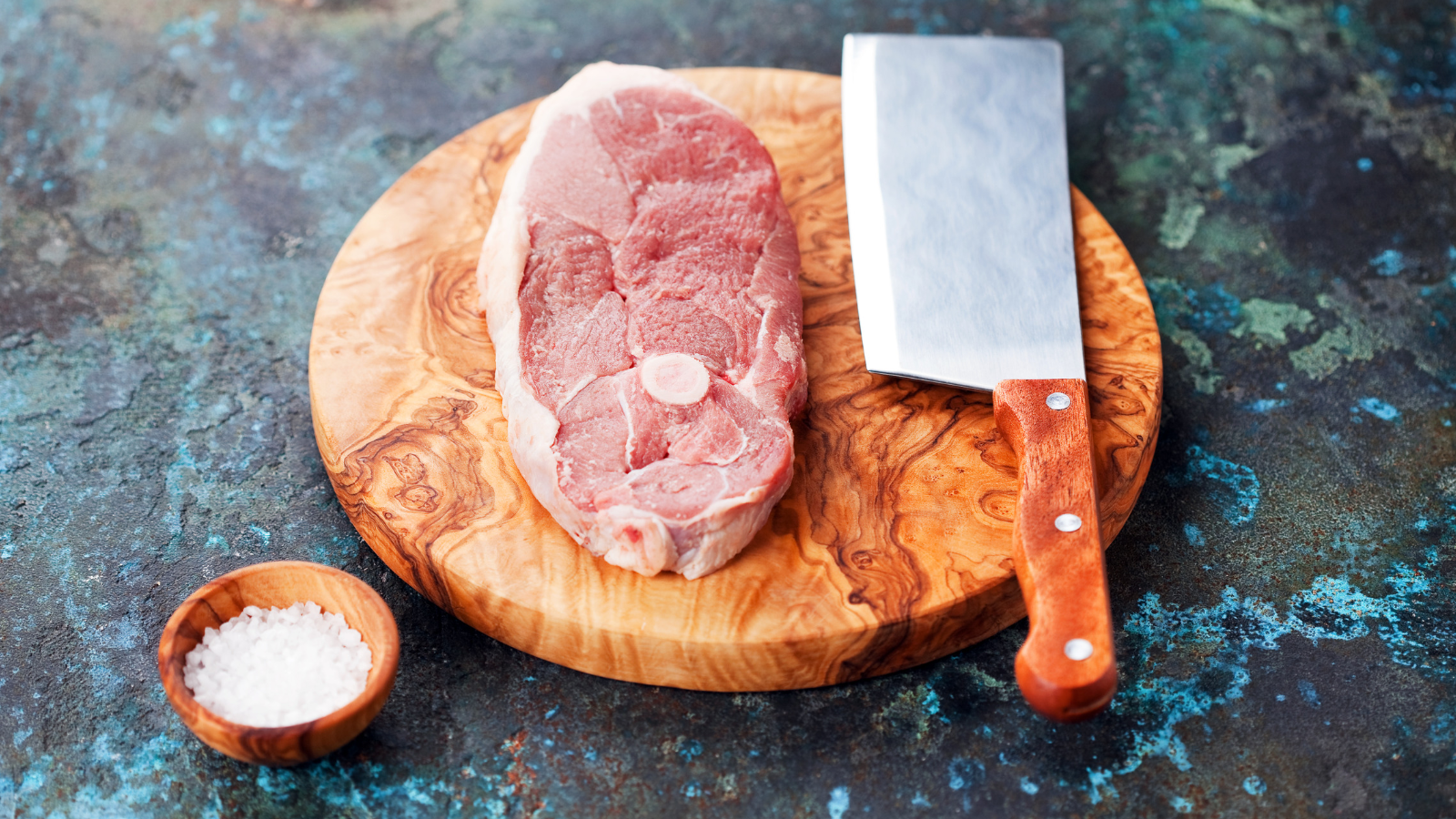
A few months later, you pull one out for dinner. Inside is a big, round, bone-in cross section of hind leg containing three or four chunks of meat, a mess of silverskin and connective tissue, and a bone through the middle.

It says steak on the package, so you treat it like one.
Salt. Pepper. Screaming-hot cast iron or a grill. Medium rare.
Half of it turns out okay. One section is tough. Another is chewy. One piece browned beautifully while another somehow stayed grey. Somewhere in there is a strip of connective tissue you could floss your teeth with.
And suddenly you’re wondering why everyone keeps telling you venison makes such good steak.
Well… maybe venison isn’t the problem.
Maybe the steak is.
This exact problem—learning to look at an animal as a collection of individual cuts instead of a pile of generic steaks, roasts, and burger—is a big part of why Justin Townsend and I wrote Cooking by Cut: A Modern Guide to Big Game Butchery and Cooking. The way an animal is cut determines what you can do with it in the kitchen, and few cuts demonstrate what happens when we ignore that fact better than the humble leg steak.
I’ve worked for a game processor in the past, and I’m going to establish something right away: we didn’t cut leg steaks.
Not because we couldn’t. We owned a bandsaw. We simply thought there were much better ways to break down a hindquarter.
I also currently work as a seasonal butcher at a guiding service. Although it would be faster and cheaper, I still refuse to cut leg steaks.
In many cases, sawing an entire hind leg crosswise into steaks is lazy butchery. Before every game processor on the continent starts sharpening their knives with my name on them, though, hunters deserve some blame too. Processors constantly hear things like, “I want as many steaks as possible,” “Don’t give me roasts,” or, “Turn the whole deer into steaks and burger.”
If that’s what the customer wants, the fastest way to produce a mountain of things that can technically be called steaks is to start feeding hindquarters through the saw.
The problem is that the resulting cut doesn’t make much culinary sense.
Here are seven reasons why.
Listen to our Podcast
Apple Podcasts, Google, Spotify, Amazon Music
Get a Copy of our New Book!

1. You’re Combining Cuts That Don’t Cook the Same Way
A hindquarter isn’t a single chunk of meat. It’s a collection of very different muscles that happen to live beside one another.
There is top round, bottom round, eye of round, sirloin tip, top sirloin, tri-tip, and, as you move farther down the leg, shank. Even within some of those larger groups, tenderness, grain, connective tissue, and ideal cooking methods vary.
Top round is fairly lean and reasonably tender. I use it for thin steaks, cutlets, schnitzel, roasts, jerky, stir-fries, and sandwiches.
Bottom round tends to be firmer and often carries more connective tissue. It can make a good roast, cure nicely, slice thin, or even take a braise.
Eye of round is lean, tidy, and uniform. It’s excellent for jerky, bresaola, curing, and thin slicing, but it can be unforgiving as a thick steak.
Top sirloin, meanwhile, is genuinely good steak meat.
Sirloin tip, or the football roast as it’s commonly known, is great for curing and smoking, as well as reverse-searing and dry roasting to medium rare.
Tri-tip is delicious cooked whole, either grilled, smoked, or seared, then sliced thinly against the grain.
Shank (which generally doesn’t get included in the leg steak) wants almost the exact opposite treatment—cooked low and slow in lots of liquid.
Now saw straight through several of those muscles and cook them all simultaneously.
You might get one piece perfectly medium rare while the section beside it remains tough. Cook the whole thing longer in an attempt to tenderize that tougher muscle and you overcook the piece that was already tender.
There is no magical internal temperature where several different cuts suddenly agree to become perfect at the same time.
It’s roughly equivalent to throwing a chicken breast and a chicken thigh on the grill and assuming they’ll cook identically because they’re both chicken.
2. Cross-Cutting Works for Osso Buco, Not Steak
There’s an important caveat here: cutting through several muscles isn’t inherently bad.
Look at osso buco.
A cross-cut shank contains multiple muscles, fascia, tendons, connective tissue, bone, marrow, and all sorts of seams. On paper, that sounds suspiciously similar to everything I’m complaining about in a leg steak.
The difference is how it’s cooked.
Nobody sears an osso buco for three minutes per side, pulls it off the heat medium rare, and wonders why they can’t chew it.
You braise it.
Hours of low, moist heat allow collagen to break down into gelatin. Tough connective seams soften. Meat becomes tender. The braising liquid grows richer. Everything that made the shank difficult when raw becomes an advantage. Same thing goes for cross-cut neck roasts.
The leg steak takes a similarly complicated cross section and essentially tells the cook: “Treat me like a ribeye.”
That’s the problem; butchery and cooking method need to make sense together.
3. The Connective Tissue Is Now Inside Your Steak
When you seam out a hindquarter properly, many of the major muscles naturally separate from one another.
That gives you the opportunity to expose silverskin, fascia, and other connective tissue and decide what needs trimming.
Saw straight across the leg and all of that material stays put.
Now it’s running directly through your dinner.
This is one of those situations where venison gets blamed for bad butchery.
Someone bites into a leg steak. The meat itself may actually be perfectly tender. Then they hit a piece of silverskin they can’t chew through and conclude that venison is tough.
No, you’re chewing silverskin. Those aren’t the same thing.
Connective tissue can be wonderful when given time to break down in a braise. In a steak that spends six minutes in a skillet, it isn’t going anywhere, except maybe between your teeth.
4. Calling It a “Steak” Tells You to Cook It Wrong
This might be my biggest complaint.
The word steak comes with instructions even when nobody gives you any.
When you see steak, you think grill. Cast iron. High heat. Salt and pepper. Medium rare, maybe medium.
Nobody opens a package labelled VENISON LEG STEAK and thinks, “Perfect. I’ll gently braise this in stock for three hours.”
The name has already encouraged one of the least suitable ways to cook the thing before you’ve even taken it out of the package.
Then parts of it turn out tough and chewy, and another hunter walks away believing deer doesn’t make good steak.
5. Leg Steaks Destroy Better Cuts
A hindquarter isn’t some wasteland of miscellaneous leg meat that desperately needs to be transformed into something useful.
It’s already full of useful cuts.
A top sirloin has an identity. So does an eye of round. So does a tri-tip. So does a shank.
Each tells me something about how I might cook it.
If a package says TOP SIRLOIN, I have ideas immediately.
If it says EYE OF ROUND, I have a different set.
If it says SHANK, I know exactly where we’re going.
If it says LEG STEAK, good luck.
You’re not really creating one useful new cut by sawing across the entire hindquarter. You’re erasing the identity of several existing ones.
Would we do this to beef?
Imagine walking into a butcher shop and asking for a ribeye, only to receive a random cross section of several unrelated muscles and a bone.
“It’s all beef.”
You’d have questions.
Yet hunters routinely accept a vocabulary for wild game consisting almost entirely of steak, roast, stew meat, and burger.
I assure you, we can do better than that.
6. They’re Convenient for the Processor, Not the Cook
Here’s the part that may irritate some processors.
Leg steaks are fast.
Put a hindquarter on the bandsaw.
Slice. Slice. Slice. Slice.
Wrap it.
Done.
Compare that with seam-butchering a hindquarter, identifying the major muscles, trimming them, portioning them, and labelling them separately.
That takes more time, and time costs money.
That’s fair.
I’ve worked in processing. I know properly breaking down an animal takes labour.
But we still didn’t cut leg steaks because we thought there were better ways to give customers useful meat.
Hunters also need to acknowledge that better butchery may cost more. Everything else has gone up in price over the last few decades, yet somehow some people still expect a deer to cost what Dad paid to have one cut up in 1987.
You can’t simultaneously demand cheap processing, fast turnaround, and meticulous seam butchery and then act surprised when compromises appear.
7. They Teach Us the Wrong Way to Think About Meat
This is the bigger issue behind all of it.
Leg steaks represent an old way of thinking about wild game where an animal gets reduced to three categories:
Steak.
Roast.
Burger.
But a cut shouldn’t be defined only by the shape somebody happened to cut it into.
Instead, ask where the muscle came from.
How much work did it do?
How much connective tissue does it contain?
What direction does the grain run?
How tender is it?
What is that particular cut actually good at?
Then choose a cooking method.
Don’t begin with, “I want steak,” and force the animal to comply.
Understanding cuts gives you more options, not fewer.
A top round and a shank are both parts of the hind leg. That doesn’t mean they should ever be cooked the same way.
The leg steak is what happens when we pretend that distinction doesn’t matter.
So What If Your Freezer Is Already Full of Them?
Don’t throw them out!
There’s still perfectly good meat in there. The processor hasn’t ruined the muscles; they’ve simply been bundled together inconveniently. These “steaks” are still obviously edible, but they’re certainly not ideal.
The easiest rescue is to stop treating them like steaks.
Brown them and braise them with stock, wine, beer, tomatoes, onions, or whatever else suits the dish. I wouldn’t deliberately choose a leg steak over neck, shoulder, or shank for braising, but it’s still considerably better than grilling one and hoping for a miracle.
You can also thaw the steak, separate the obvious muscle groups along their seams, trim out connective tissue, and use the individual pieces for steak bites or other small preparations.
Remove the bone and pound the meat thin for schnitzel, chicken-fried venison, or breaded cutlets.
Cube usable sections for kebabs or quick sautés.
Or my personal favorite, slice it thinly across the grain for stir-fries, bulgogi, cheesesteaks, fajitas, stroganoff, or noodle dishes.
And yes, if you’re left with some mangled little pieces that aren’t worth obsessing over, grind them.
There is no medal for preserving every ounce of a deer as steak.
The goal is simply to understand what you’ve got before deciding how to cook it.
Hunters spend extraordinary amounts of money and effort getting an animal onto the ground. Rifles, bows, optics, tags, fuel, clothing, scouting, travel, and hours upon hours in the woods.
It seems strange that once the animal is finally in our hands, we’d suddenly stop caring about the meat.
Learning how a hindquarter comes apart takes surprisingly little time, and it’s one of the most useful bits of butchery a hunter can learn.
The food gets better, you get more options, and the next time someone asks how many steaks you want from your deer, you can ask a much better question:
What steaks am I actually getting?
Learn the Cut, Then Cook It
This whole argument is also exactly why Justin Townsend and I wrote Cooking by Cut: A Modern Guide to Big Game Butchery and Cooking.
Most wild-game cookbooks begin with a species. Here’s a chapter of deer recipes. Here’s elk. Here’s moose. Maybe bear gets tucked in somewhere near the back.
But that isn’t really how meat works.
A top sirloin from a deer has more in common, culinarily speaking, with a top sirloin from an elk or moose than it does with the shank sitting a couple of feet away on the same animal. Species matters, of course, but the cut often tells you far more about how that piece of meat wants to be cooked.
That’s the entire philosophy behind Cooking by Cut.

Instead of handing you another stack of recipes and hoping you happen to have the right package in your freezer, the book teaches you how a big-game animal is actually put together, how to identify and butcher the individual cuts, what makes each one different, and how those differences should determine what happens next in the kitchen.
There is expert butchery and technical advice, detailed breakdowns of the major cuts, cooking methods designed around what those cuts actually do well, personal essays, and recipes pulled from food traditions around the world. More importantly, it’s meant to give hunters confidence both at the cutting table and at the stove.
Because the better you understand the animal, the less likely you are to end up with a freezer full of anonymous packages marked STEAK, ROAST, and BURGER.
And the less likely you are to waste an excellent top sirloin, tri-tip, eye of round, shank, or any of the other useful pieces hiding inside that hindquarter simply because nobody taught you what they were.
If you butcher your own animals, Cooking by Cut belongs beside your cutting board.
If you pay somebody else to butcher them, you need it just as much, because it will help you understand what to ask for, what you’re actually getting back, and what to do with it once it reaches your kitchen.
Modern hunters spend too much time, money, and effort acquiring wild meat to remain satisfied with “steak, roast, or burger.”
Learn the cuts.
Cook them for what they are.
And please, for the love of venison, stop asking for as many leg steaks as possible.