
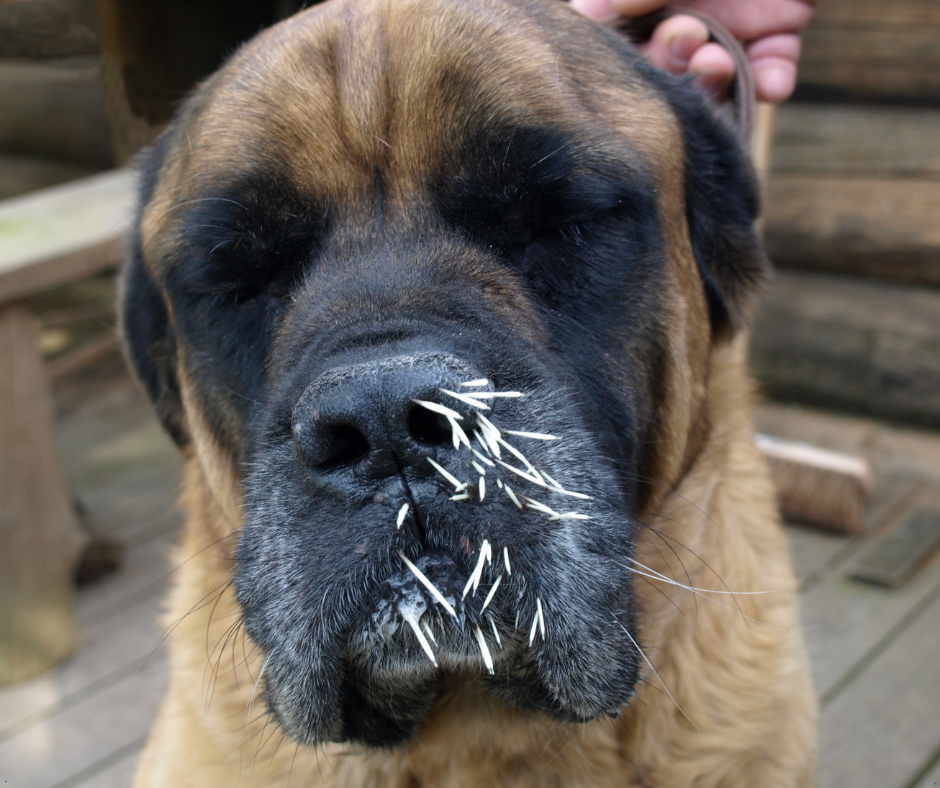
When $%&! Goes Wrong: Dogs and Porcupines/Skunks
By Adam Berkelmans
Our adventures to procure wild food, whether through hunting, fishing, or foraging, can bring us into some extreme situations and sometimes, despite our best efforts, $%&! can go wrong. In this series, we’re going to talk about different adverse situations you may find yourself in, and the best ways to deal with them.
This month, we’re talking about encounters between your dog and porcupines and skunks.
This will apply to anyone who spends time hunting, foraging, fishing, scouting, camping, or hiking in the backcountry with their dogs as well as to those at home, whether in the country or city. Animal encounters can occur anywhere and unfortunately, our furry friends love investigating and chasing our spiky and stinky friends, which inevitably leads to small crises.
This is what to do if your dog gets stuck by a porcupine, or sprayed by a skunk.
Listen to our Podcast
Apple Podcasts, Google, Spotify, Amazon Music
Try our Delicious Wild Fish and Game Spice Blends!

Porcupines

Porcupines are North America’s second-largest rodent, next only to the beaver. They can grow upwards to 20 lbs and are covered in up to 30,000 quills, a specialized type of hair or fur. These quills are hollow, tipped with a barb, and are only lightly attached to the animal, meaning that they can easily be left behind in a predator that gets too close.
Porcupines cannot throw their quills, but can quickly lash their tail leaving a curious dog with a face full of barbed needles that then work their way through the skin and into the body. These quills can move inwards at up to 1mm per hour and can eventually become very problematic, reaching organs, or causing abscesses.
Porcupines are generally nocturnal, but can often be found during the day as well. They move slowly, shuffling along the ground, but also spend a lot of time climbing trees and can even be found swimming. Porcupines have poor eyesight, but a great sense of smell.
Porcupine and Dog Encounters
Naturally curious dogs will often find themselves with a face, chest, or paws full of quills after sniffing at the rear end of a porcupine. These quills are very painful to dislodge and can be dangerous if any are left behind.
The first thing to ask yourself is if you should bring your dog to the vet. A vet will be very experienced with pulling out quills and will be able to sedate the dog, making the experience far less traumatic and painful – for both dog and owner.
If the dog has quills in its mouth or near its eyes, or if its temperament won’t allow you to manhandle it while it is in pain, then the vet is the right choice. Also, if you don’t have the tools or confidence required to do the job properly, then you should certainly bring the dog to a vet. Remember, a missed quill or two can cause very painful and expensive problems further down the road.
If the quills don’t look too bad and you’re confident that you can remove them and that your dog will let you without harming you in pain or panic, then this is how to remove them.
Mythbusting
First, let’s get a few myths out of the way.
DO NOT cut the quills. Some people insist that the quills will “deflate” once cut and become easier to pull. Veterinarians disagree with this and point to the fact that cut quills can be harder to remove, are easier to lose, and will often splinter and become more of a problem.
DO NOT grease up your dog’s skin. Some people say that lubricating the skin will allow the quills to slip out more easily. Since the quills are barbed, no amount of grease will slide them out, you’ll just end up making your dog more difficult to hold onto during the process.
How to Remove Quills
If you’ve decided to do the work yourself and are confident that your dog doesn’t need to go to the vet, then the porcupine quills should be removed as soon as possible.
- Firmly hold down your dog to prevent squirming. Don’t allow the dog to brush at the quills with its paws or a wall/object
- If necessary, use a slip lead or muzzle to prevent the dog from biting
- Use needle nose pliers or a multi-tool with pliers to firmly grasp onto each quill (or a very small number of them) at the base and slowly pull out. This will be very painful for the dog and will result in a reaction
- Continue to pull one, or a small few, at a time, slowly and firmly, until you’ve found them all
- For smaller quills you may need to switch to tweezers or hemostats (see image below)
- A quill jig is a tool that can help remove quills from inside a dog’s mouth. They are available for sale online. A rod or wooden dowel can also be used to keep a dog’s mouth open
- Spend extra time looking for more quills. Look inside the mouth and around the gum line as well as around the pads of the feet
- Be sure to keep the removed quills in a place like a cup, bowl, or gauze that won’t be rolled over by the dog
- Talk to your vet about dog-safe anti-inflammatories to reduce pain and swelling
- You may need to carry your dog to safety. A harness is a valuable piece of kit in this situation if you have a large dog

If you notice any odd behaviour, lethargy, cough, major swelling, or open wounds in the days following the procedure, bring your dog to the vet immediately.
Porcupine First Aid Kit
- Needle nose pliers or Multi-Tool
- Tweezers or hemostats
- Quill Jig (optional) or wooden dowel
- Slip lead or muzzle
- Dog carrying harness
- Gauze
Skunks

Striped skunks are instantly recognizable due to their striking black-and-white appearance and can be found throughout much of North America. Skunks are nocturnal and subsist mostly on a diet of insects. They can be found in wooded areas, agricultural regions, and urban areas, where they are attracted to trash. When threatened, a skunk will turn around, stamping its feet and raising its tail, creating a threatening pose before spraying a foul-smelling chemical several meters.
The chemical is produced by two glands alongside the anus that contain about 15ml of the oily musk. It is mostly harmless unless it gets into the eyes, which can cause burning, and in some rare cases, blindness. Anything that gets hit by the spray, including your dog, will stink for a long time if nothing is done about it. One of the chemicals in a skunk’s spray activates with water, so even once the smell is gone, if your dog gets wet, it will likely smell skunky again.
Skunks can usually be found in rural/wild areas around dusk and dawn, while in urban areas, they can usually be seen in profusion the night before garbage day, when the streets are lined with trash.
Can Skunk Spray Hurt My Dog?
Though mostly innocuous, a skunk’s spray can be dangerous if it gets into the eyes, where it can cause redness, pain, swelling, damage to the cornea, and even blindness (often temporary). If the spray is inhaled, it can potentially cause damage to the respiratory tract. If a dog gets the spray in its mouth, it may drool or vomit.
In very rare cases, a skunk’s spray can damage red blood cells and cause anemia. If your dog is showing signs of blindness, lack of appetite, or lethargy 1-3 days after being sprayed, take it to a vet immediately.
What To Do If Your Dog Gets Sprayed
- If your dog is likely to be sprayed at some point, keep a bottle of store-bought skunk odour remover in the home
- Keep the dog outside if possible so as to keep the smell off of carpets and fabrics in the home
- Immediately rinse out its eyes and mouth with the hose
- To neutralize the odour associated with skunk spray, you need to break down the oils so that they can be washed off the fur or skin
- Tomato juice and vinegar are not worth using to clean your dog
- Your best bet is to use a commercial odour neutralizer like Thornell’s Skunk-Off or Nature’s Miracle Skunk Odor Remover (or any other regional brands), follow the instructions on the back of the bottle closely
- If you don’t have a commercial cleaner available, you can make a homemade one (see below)
- Note that the homemade remedy contains hydrogen peroxide which will lightly bleach your dog’s fur
- Also note that the older the hydrogen peroxide is, the less chance it will work
From the Cornell Richard P. Riney Canine Health Center, Canine Health Information:
Homemade skunk remedy
Ingredients
- 1 quart of 3% hydrogen peroxide
- 1/4 cup baking soda
- 1-2 teaspoons of dishwashing liquid, such as Dawn
Instructions
- Wear gloves. Rinse the dog’s eyes with cool water if sprayed in the face.
- Mix the ingredients in a bowl and immediately apply the solution when it starts to bubble.
- Lather the mixture throughout the skunked area on your pet. Be careful to avoid the eyes.
- Let sit for 5 minutes, and then rinse thoroughly with warm water. Repeat as necessary if the odor is still present.
- Finish by bathing with regular pet shampoo (optional).
- Towel dry and let them finish drying in a warm area.
- Discard all unused solution. Do NOT store or save.
DON’T
- Don’t make the mixture beforehand or store it in a closed container. The chemical reaction between hydrogen peroxide and baking soda will make the container burst.
- Don’t save any unused mixture. It can’t be bottled. The chemical reaction of pressure from combining hydrogen peroxide and baking soda will make it burst, and the subsequent explosion can cause injuries.
- Don’t smoke while shampooing, since this mixture is flammable.
DO
- Do use the homemade solution right after it is mixed and still bubbling.
- Do repeat bathing with the homemade solution a few times to remove the smell completely.
- Do wear old clothes and use towels that you don’t mind getting bleached. Hydrogen peroxide will lighten black hair to a bronze color, which will not return to its usual shade until it grows out.
- Do keep the solution out of your pet’s eyes. It can be irritating enough to cause shallow corneal ulcers.